Ozone Water Treatment Beyond Bottling: Industrial Uses, Cooling Towers & Water Disinfection

Ozone is often associated with bottled water production, where it plays an important role in water disinfection and sanitation. But its usefulness does not stop at the bottling line.
Today, ozone water treatment systems are also being considered for cooling towers, industrial process water, equipment sanitation, commercial facilities, and other applications where controlling microorganisms and oxidizing unwanted compounds are important. Because ozone is generated on-site and is highly reactive, it can be integrated into treatment systems without relying entirely on stored treatment chemicals.
For businesses evaluating new water-treatment options, the bigger question is not simply whether ozone works. It is where ozone makes sense and how it can be incorporated into an existing treatment strategy.
From Bottling Plants to Industrial Water Systems
In bottled water production, ozone is commonly used as a disinfection and sanitation step. It can be introduced into treated water before filling and can also be used in bottle-rinsing and related sanitation processes. Ozone is effective because of its strong oxidation properties and ability to react with microorganisms and organic compounds.
That same chemistry makes ozone relevant to much broader industrial applications.
A manufacturing facility may be concerned with biological growth in a water loop. A commercial operation may need improved sanitation of water-contact equipment. A facility with large cooling towers may be looking for better control of biological fouling while managing chemical and water consumption.
These are very different applications, but they share a common requirement: maintaining better control over water quality.
Where Ozone Can Make a Difference
Rather than viewing ozone as a solution for one specific industry, it is more useful to look at the problems it can help address.
1. Cooling Tower Water Treatment
Cooling towers continuously circulate water while being exposed to air and environmental contaminants. As water evaporates, dissolved minerals can become concentrated, while microorganisms and organic material can contribute to biological fouling.
That makes cooling tower water management a combination of biological, chemical, and mechanical challenges.
Ozone cooling tower treatment can be used as part of a program designed to control microorganisms and biofilm. Ozone is an oxidizing biocide, and properly designed systems can help manage biological growth within circulating cooling water.
For large facilities, this can be particularly interesting because cooling towers can consume significant quantities of water and traditionally rely on chemical treatment programs. Depending on the system design and water chemistry, ozone may help reduce reliance on certain chemical treatments and support improved water management. It should not, however, be viewed as an automatic replacement for every chemical treatment program.
The most effective approach is to evaluate the actual cooling system, water chemistry, operating conditions, and treatment objectives before selecting an ozone system.
2. Industrial Process Water
Manufacturers often use water throughout production, cleaning, cooling, or material-processing operations. Even when the water is not intended for drinking, microbial control can still be important.
Ozone can be used where oxidation and disinfection are required. It can also react with certain organic compounds and other oxidizable substances, depending on the characteristics of the water.
This creates opportunities across industries such as food and beverage manufacturing, commercial processing, and other facilities with water-intensive operations.
The objective is not necessarily to replace an entire treatment train. Ozone is often most effective when it is designed as one component within a broader system that may include filtration, commercial water purification, reverse osmosis, softening, or other treatment technologies.
3. Equipment and Facility Sanitation
Water-treatment requirements extend beyond the water itself.
Tanks, pipes, filling equipment, processing lines, and other water-contact surfaces must also be maintained in sanitary condition. Ozone can be incorporated into clean-in-place and other sanitation processes because of its ability to react with microorganisms and organic material.
For facilities where cleaning and sanitation contribute to production downtime, on-site ozone generation can be worth investigating as part of a carefully engineered sanitation program.
The exact concentration, contact time, water temperature, and system design all influence treatment performance. That is why simply installing an ozone generator is not enough; the entire treatment process has to be considered.
Ozone for Water Disinfection
One of ozone’s most recognized applications is disinfection.
Ozone is a strong oxidant that can inactivate microorganisms in appropriately designed water-treatment systems. The effectiveness of treatment depends on factors such as ozone dose, mixing, water quality, and contact time.
This is particularly useful in applications where microbial control is a major objective.
However, ozone has an important characteristic that system designers need to understand: it does not provide a persistent disinfectant residual in the same way as some conventional chemical disinfectants. For applications involving distribution or storage, the overall treatment strategy may therefore require additional protection or a secondary disinfection approach.
In other words, ozone is a powerful treatment technology, but it should be engineered around the requirements of the complete water system.
Why On-Site Ozone Generation Matters
One practical advantage of ozone is that it is generally generated at the point of use rather than stored and transported in its finished form.
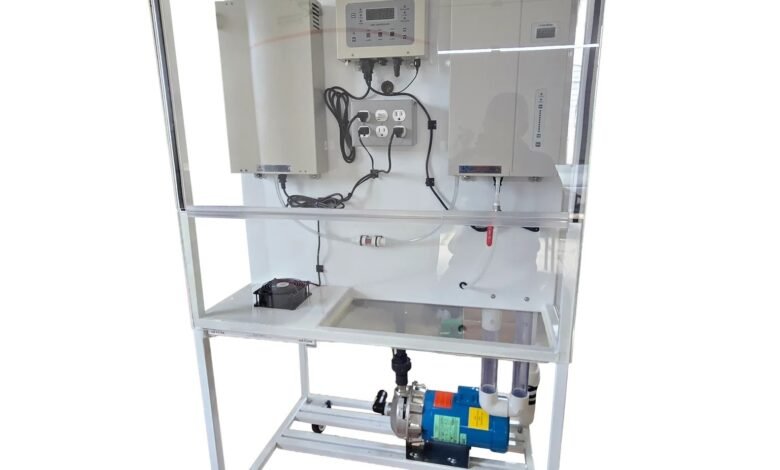
A complete ozone water treatment system may include an ozone generator, air dryer, injector, pump, contact tank, monitoring equipment, and controls. The configuration depends on the application and the water flow.
For example, a high-flow industrial installation will require a very different approach from a small commercial sanitation system.
On-site generation can simplify certain chemical logistics, but ozone systems also require appropriate ventilation, off-gas management, compatible materials, and safety controls. EPA guidance notes that ozone is highly reactive and that off-gases must be properly managed to avoid worker exposure.
Ozone and Reverse Osmosis: Different Jobs, Complementary Technologies
Ozone is sometimes discussed alongside reverse osmosis, but the two technologies perform very different functions.
A reverse osmosis system is primarily used to remove dissolved salts, minerals, and other contaminants through a membrane process. Ozone, on the other hand, is primarily used for oxidation and disinfection.
That means a facility may use both technologies within the same overall water-treatment strategy.
For example, a water bottling plant could use reverse osmosis to improve the quality of incoming water and ozone as a downstream sanitation or disinfection step. In other industrial applications, RO may address dissolved contaminants while ozone focuses on biological control or oxidation.
The right sequence depends on the source water and the treatment objective.
What Should Be Considered Before Installing an Ozone System?
Every ozone application should begin with the water and the process rather than the equipment catalogue.
Important factors include:
Water flow: Ozone production and injection requirements must match the actual flow rate.
Water chemistry: Organic matter, minerals, temperature, pH, and other characteristics can influence ozone demand and treatment performance.
Contact time: Ozone needs adequate transfer and contact with the water to achieve the desired treatment.
Materials: Because ozone is highly reactive, system components must be selected for compatibility with the application.
Monitoring: ORP and other control methods can be incorporated where appropriate to help manage treatment conditions.
These considerations are especially important for large industrial systems, where an incorrectly sized or poorly integrated ozone system can reduce the expected benefits.
A Broader Role for Ozone in Water Treatment
The future of ozone technology is not limited to the bottled water industry.
Cooling towers, industrial process water, equipment sanitation, commercial water systems, and other applications can all present situations where oxidation and microbial control are important. The technology can also work alongside other treatment methods instead of replacing them.
For businesses considering an industrial ozone water treatment system, the most important step is understanding the specific problem first. Is the priority microbial control? Biofilm management? Water sanitation? Oxidation? Reduced chemical handling? Each objective can lead to a different system configuration.
Companies such as Mobetta Water can help evaluate these requirements and identify equipment suited to the application. With experience serving the water market since 2001, Mobetta Water supplies ozone generators, air dryers, ORP controls, and packaged ozone treatment systems for commercial and industrial water-treatment applications.
As water-intensive industries continue looking for practical ways to improve sanitation and treatment efficiency, ozone deserves consideration beyond the traditional bottling environment. Its versatility makes it a valuable technology to evaluate wherever water quality, disinfection, and biological control are central to reliable operations.