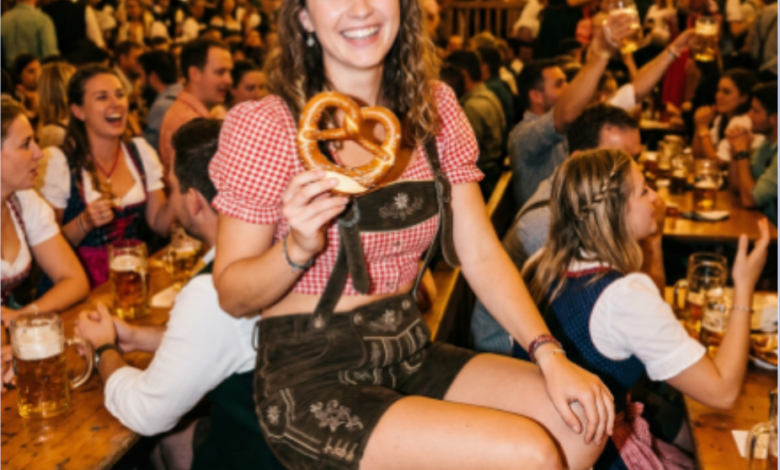
For women planning 2026 festival season, lederhosen for women have moved from novelty alternative to established mainstream choice — visible in growing numbers at Munich’s Theresienwiese and at every major American Oktoberfest. The appeal is practical as much as stylistic: leather shorts with suspenders free you to climb beer-tent benches, dance for hours, and navigate crowded festival grounds in ways a full skirt never quite allows, while still reading as unmistakably Bavarian. For a generation of festival-goers who value movement and a playful register over classic femininity, the women’s lederhosen look answers a real demand.
This guide covers why the switch is happening, what quality women’s lederhosen construction involves, how to fit and style the look, and where it sits within the broader tradition.
Why the Switch Is Happening
Three forces drive the shift. Comfort leads: a twelve-hour festival day of standing, dancing, and bench-climbing is simply easier in fitted shorts than in a gathered skirt and apron. Style follows: the lederhosen silhouette photographs with a confident, playful energy that contrasts deliberately with dirndl elegance, and mixed friend groups increasingly split between the two looks for visual variety. Practicality closes it: leather shorts shrug off spilled beer, bench grime, and October drizzle that punish delicate dirndl fabrics, and they layer easily with tights and cardigans as temperatures drop.
None of this displaces the dirndl — most women who buy lederhosen own both and choose by occasion. It simply means the category now has two legitimate mainstream answers instead of one.
What Quality Women’s Lederhosen Look Like
Women’s lederhosen follow the same construction logic as the men’s garment, cut for women’s proportions. Quality versions use genuine leather — suede-finish cowhide at the accessible tier, softer goatskin or premium deerskin above it — with a fitted waist, shorter inseam than men’s cuts, and hip proportions that sit correctly on a woman’s frame. Traditional detailing carries over: front flap or button styling, embroidered motifs on the front and side panels, and H-bar suspenders with decorative breastplate.
The costume-grade warning signs also carry over. Thin vinyl or polyurethane “leather,” printed-on embroidery, elastic waistbands replacing proper closures, and flimsy clip-on suspender imitations all mark products that photograph poorly and split at the seams within a wearing or two. Genuine leather at women’s accessible tiers realistically starts around $90 to $130; listings far below that are costumes.
Fit and Sizing for Women’s Cuts
Fit determines whether the look lands. Women’s lederhosen should sit snugly at the natural waist without gapping, with the leather molding slightly looser across the first several wears as it breaks in — order true to your measured waist rather than sizing up. Inseam options range from short festival cuts to Bermuda-length kniebund styles reaching the knee; shorter cuts read younger and warmer-weather, knee-length cuts read more traditional and suit cooler October days.
Suspenders are adjustable and optional in many women’s styles — some wearers keep the H-bar for full traditional character, others drop it for a cleaner waistline under a cropped blouse. Both are established looks.
Where the Look Sits in Bavarian Lederhosen Tradition
Some first-time buyers hesitate over whether women wearing the garment is “allowed,” and the tradition itself answers clearly. The bavarian lederhosen heritage began as practical Alpine workwear — leather trousers built for farm and mountain labor — and working rural women wore practical leather garments long before the modern festival era. Contemporary Munich has settled the question in practice: women’s lederhosen are sold by traditional Trachten houses, worn openly across the Wiesn, and treated as a normal register of festival dress rather than a transgression.
The honest convention distinction is formality, not gender. Strictly ceremonial contexts — traditional weddings, formal church festivals — still default to dirndl for women, while festivals, beer gardens, and casual Bavarian events fully welcome the lederhosen look. Matching register to occasion is the only rule that matters.
Styling the Complete Look
The shorts anchor the outfit; the styling completes it. Classic pairing puts a white or checkered cropped blouse under the suspenders — red-and-white or blue-and-white gingham reads most traditionally festive. Knee-high socks or sheer tights bridge to footwear; ankle boots deliver the signature silhouette, while white sneakers give a deliberately modern festival remix that has become its own established look.
Finish with restrained Bavarian accessories: a heart-charm or Edelweiss necklace, braided hair or loose waves, and a small crossbody bag. For cooler evenings, a fitted traditional cardigan layers cleanly over the blouse without hiding the suspender detailing.
Buying Smart for 2026
Three checks cover most of the purchase risk. Verify genuine leather in the material specification — suede cowhide minimum, goatskin or deerskin for softer premium feel. Confirm women’s-specific cut rather than a unisex or men’s pattern relabeled; hip and waist proportion is the whole fit story. And order early: women’s sizes in popular styles sell through by late August every season, and 2026 demand is tracking higher than any prior year.
Frequently Asked Questions
Are lederhosen acceptable for women at Oktoberfest?
Completely. Women’s lederhosen are established mainstream festival wear in Munich and at American events alike.
What should women’s lederhosen cost in 2026?
Genuine-leather accessible tiers run roughly $90 to $180; premium goatskin and deerskin cuts run $180 to $350. Far-cheaper listings are vinyl costumes.
Short or knee-length cut?
Short cuts suit warm weather and a younger festival register; knee-length kniebund styles read more traditional and handle cool October days better.
What do I wear with them?
Cropped white or gingham blouse, knee socks or tights, ankle boots or clean sneakers, and simple Bavarian jewelry.
How should they fit at purchase?
Snug at the natural waist — leather relaxes slightly with break-in, so order to your measured waist rather than sizing up.
Can I skip the suspenders?
Yes. Many women’s styles wear cleanly without the H-bar; keeping it maximizes traditional character.